

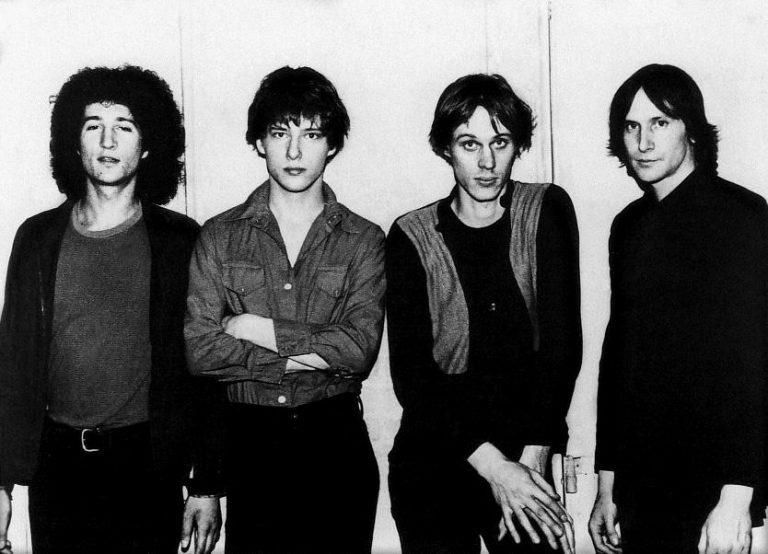
The death of Richard Lloyd has pushed me back down the rabbit hole that is the New York punk scene of the 1970s and the strange, impossible-to-replicate cultural moment that surrounded it. There’s something fascinating about a scene that was such a pillar in molding the music, fashion, and visual culture of what we see today. Television, Blondie, Patti Smith, Richard Hell, and the countless musicians who passed through CBGB helped establish an entirely different idea of what a rock band could be.
Lloyd, best known as the guitarist and co-founder of Television, was an important part of that movement and unfortunately lost his battle to cancer on Nov. 7. Alongside Tom Verlaine, he helped develop a sound that was as raw and exploratory as the downtown New York environment that produced it. Marquee Moon, Television’s 1977 debut, and what I’d argue to be one of the absolute very best albums of all time, remains one of the defining records of the era and challenged the conventional expectations of punk music. Listening to it now, nearly five decades later, it’s difficult not to recognize just how much modern alternative and independent music owes something to that record.
Television’s influence on music is difficult to overstate, particularly when considering how much they challenged the boundaries of what punk was supposed to sound like. At a time when the genre was becoming increasingly associated with stripped-down simplicity, Television took an entirely different approach. Tom Verlaine and Richard Lloyd’s intertwining guitar work brought a conversational quality to their arrangements. Marquee Moon helped establish a blueprint for generations of alternative and indie rock musicians, influencing everyone from post-punk bands to the guitar-driven indie acts that followed decades later. You can hear traces of their approach in the work of bands like The Strokes, Interpol, Geese, and countless others.
But the legacy of the New York punk scene expands far beyond its discography. Its influence can be found in the way modern musicians dress, the way they carry themselves, the way they approach visual art, and even the way their fans understand what it means to participate in music culture. I’m sure there are some young modern frontmen with Pinterest boards full of Richard Hell’s face, but most of the influence has gotten buried and gone unrecognized throughout the many cycles of music that have graced us in recent years. These boys don’t even know who they’re ripping off anymore!
For some background, I’m a writer second, photographer first—a photojournalist who shoots music primarily. When I was around thirteen, my grandpa took me into our garage and pulled down our attic’s ladder with one goal in mind—finding his old boombox and the music collection that went with it. We uncovered the boombox and a large box of CDs and cassettes and then spent hours in the garage as he showed me each album and talked through the bands and what they meant to him.
As he gave me countless cassettes of The Who, Echo & The Bunnymen, and Led Zeppelin, one name kept coming up. “Where is that damn Tom Verlaine cassette?” I’d never heard that name before, and as it turned out, he could no longer locate the specific album he was trying to find, but I knew that he had to be important if my grandpa was this torn up about not finding his tape. I went home and researched Verlaine, which resulted in me being a huge Television fan within a couple of months, and within a couple more I had a photo of Richard Lloyd, the band’s guitarist, plastered to the back of my bedroom door.
The specific photo was taken in 1977 by David Godlis, and it was of Richard in a hospital gown connected to an IV pole, just standing in the hospital’s waiting room. Lloyd was getting a blood purification procedure done in the East Village of New York, following heavy drug use. Godlis was sent on assignment by Rock Scene, and the photoshoot was going to serve as an explanation for why Television’s LP was delayed. You can find the photos in this Dazed article, along with an interesting interview with Godlis. He mentions Richard selling pot out of his hospital bed, which I also read about in the book “Please Kill Me” by Legs McNeil and Gillian McCain, an uncensored oral history of the punk scene in 1970s New York.
Afterwards, we went back to Richard’s hospital bed, and he closed the curtain around us for some privacy. Then he began weighing out pot on a small scale behind the curtain, which I think he was selling to someone. An old guy at the next bed started asking him, ‘What’s going on in there?’ Richard just told him, ‘Shut up. Mind your own business.’
I recently found myself revisiting “Please Kill Me” following Lloyd’s death, and I immediately knew that I’d be sent back into my obsession with this specific scene. The book, told through interviews with the musicians, artists, writers, and other personalities who inhabited the scene, is one of the most fascinating accounts of a musical movement I’ve come across. Revisiting the book with Lloyd’s passing in mind, I realized just how much of my initial draw to photography and music documentation can be attributed to this scene specifically.
Godlis’ photographs of Lloyd were among the first images that made me understand what I wanted to do with a camera. Like “Please Kill Me,” they offer a glimpse into the rather unconventional lives these musicians were leading, even outside of the already unconventional career paths they were pursuing.
Revisiting this book also brought me back to another figure whose influence on the scene deserves just as much attention: Richard Hell.
If Television helped redefine what punk could sound like, Hell helped redefine what it could look like. Hell was in several important early punk rock bands, including Neon Boys, Television, and the Heartbreakers, after which he formed Richard Hell & the Voidoids; he clearly spent a healthy amount of time on stage and in the scene’s eyes. He was the first to popularize spiky, self-cut hair, torn and ragged T-shirts fastened with safety pins, and clothes with scrawled marker or painted slogans. His wardrobe choices were practical responses to being broke, as he moved to New York from Kentucky at the age of seventeen, completely penniless.
While managing the New York Dolls in the late 1970s, English fashion designer Malcolm Mclaren frequented CBGB, an iconic music club that served as a home for the scene, and he became familiar with Hell and his music. McLaren was particularly taken with his image, though.
After returning to London, he brought elements of Hell’s appearance to his clothing business he shared with Vivienne Westwood. Their shop, initially known as SEX, became a center for the emerging British punk aesthetic. Westwood translated these ideas into feasible fashion designs, incorporating distressed fabrics, safety pins, bondage-inspired clothing, chains, and provocative graphics. These designs would eventually become synonymous with the Sex Pistols, whom McLaren also managed.
The connection was so apparent that photographer Roberta Bayley recalled McLaren returning to England and incorporating elements of Hell’s appearance into Westwood’s designs. In 1976, a friend of Hell’s reportedly saw a photograph of the Sex Pistols in a European rock magazine and remarked that the four members looked exactly like him.
This is where the line between authentic style and commercialization was blurred, as the Sex Pistols were essentially one of the first “industry plants,” although that term had not yet been coined at the time. They became McLaren’s living mannequins, and the charm of the New York punk scene died in London. That isn’t to say its influence was any less significant, but something about the intimacy and spontaneity of the original scene was inevitably lost.
What had started as a relatively small community of musicians and artists in downtown Manhattan had become an international cultural phenomenon, and with that came an entirely different set of expectations. The irony is that a movement so fundamentally opposed to convention had inadvertently created one of the most recognizable identities in popular culture.
But reducing the New York scene to ripped shirts and a handful of influential records does it a disservice. What made downtown Manhattan so interesting was the sheer number of creative disciplines that existed alongside one another. They were poets, photographers, painters, filmmakers, writers, and artists, often all at once. The scene’s influence came from that overlap, from the fact that someone could walk into CBGB to see a band and leave having connected with an entirely different kind of artistic expression.
Patti Smith is maybe the greatest example of this. Before becoming one of the defining figures of punk rock, Patti was a poet and deeply involved in the literary circles within New York. Her 1975 debut, Horses, produced by John Cale, combined her passions for poetry and rock music.
Her relationship with Robert Mappelthrope is another important part of that history. The two met in New York in 1967 and remained close collaborators throughout their careers and dated briefly. Smith’s iconic book Just Kids details their life together. Mapplethorpe photographed the cover of Horses, and that photograph has become one of the most recognizable portraits in music history. The photo features Smith in a button-down with a jacket thrown over her shoulder and has the same relaxed feel as most photographs produced throughout this era, very simplistic with minimal production—which is perhaps why it has endured.
Mappelthorpe’s involvement with the scene expanded beyond his Horses cover and circles back to Television’s Marquee Moon, as he photographed that record’s cover as well. It’s a particularly interesting connection when considering how closely the artists in the New York scene operated.
Blondie, fronted by Debbie Harry, occupied a particularly interesting position between the downtown punk scene and the pop world that would eventually overtake it. Harry’s image was as recognizable as the band’s music as she became one of the most photographed figures of the era. She understood the relationship between music and image in a way that few performers did at the time. She challenged the idea that women in rock needed to fulfill a particular role, whether that meant being a conventional frontwoman or an extension of male band members, as did Patti Smith. They could be the personalities and creative forces behind their own work.
What ties all of these people together is that none of them existed in a vacuum. The scene was made up of all different types of creatives in different walks of life, and they were constantly influencing and challenging one another, realizing this is what made the photographs from this period so influential on my own work and experience as a photographer documenting music. It’s one thing to listen to Marquee Moon or Horses and have your mind blown in your formative years and understand their influence retrospectively. It’s another to dive into the world of the young creatives building that scene and figuring things out alongside one another. Photographs give music a physical world to exist in.
The New York punk scene of the 1970s is often remembered for its music, and rightfully so. But its greatest contribution might have been the creative freedom it showcased, at least for me. It gave artists a place to figure things out and blur the lines between disciplines that resulted in some of the greatest pieces of art we know today. Its influence can be heard in records released decades later and seen in the clothes bands are wearing today, and there are plenty of young photographers out there using photos of these figures as inspiration in their own work.
I don’t think the point is to recreate 1977, nor do I think it would be particularly interesting if we could. The circumstances that produced that scene were unique. What matters is the willingness to create something without knowing where it will lead and to participate in communities, especially with the artists surrounding you.
I never got to experience CBGB in its heyday or photograph Television in their prime. But I have the records, the books, and the photographs. They’ve given me more than enough reason to pick up a camera myself, and I see these artists reflected in almost every new band that hits my feeds. That’s pretty remarkable.