Because “alternative” currently meant Top 40, KJHK changes its tagline to “The Hawk.”
On December 3, the station became the first in the nation to broadcast a live, 24-hour signal on the internet. This was also the first year KJHK hosted Farmer’s Ball, a now decades long battle of the bands competition.
PJ Harvey released Rid of Me, an album that set a new standard for raw, emotive alternative rock.
A debate between anti-gay activist Fred Phelps and gay leaders is aired, KJHK never shied away from controversy.
KJHK did not help sponsor the infamous Pearl Jam concert on the Hill on May 2, but it was a big event in Lawrence music history.
Nirvana released Nevermind, which ushered underground and alternative music into the mainstream.
The Afghan Whigs released their extremely influential album Up In It, featuring the hit song “You My Flower.”
Journalism faculty takes control of KJHK to improve the station’s compliance with federal regulations, briefly ending student-led operations in June of that year. At student outrage and protests, control was finally given back to the students, where it has stayed since.
KJHK plays more Top 40 tunes to broaden its audience after an independent study suggests the change in format. However, this results in a campus protest and many angry letters to the Kansan. The format change along with FCC violations, leads to a brief stint of non-student management. KJHK members protested heavily. (Be on the lookout for a mini-doc about this in the coming weeks).
KJHK is granted a power increase to 100 watts. KJHK is using the same transmitter today!
Spin magazine honors KJHK for “developing and promoting” local alternative music with the Outhouse and by playing local music.
Sonic Youth released EVOL.
Jeff Hekmati and John Chaney, KJHK staffers, help organize the Outhouse venue, where KJHK starts presenting shows in August of that year.
Bill Berry and Michael Stipe interview R.E.M at the Stauffer-Flint studio ahead of their concert at Hoch Auditorium on September 14.
Thrash emerges out of Washington D.C. with bands such as Minor Threat and Black Flag. KJHK has a special program called the Monday Night Thrash Show.
New York Rocker ranks the station as one of the best in college radio.
KJHK continues to create an audience and following by supporting new and progressive bands. KJHK brought bands such as the Buzzcocks, Ultravox, the Go-Go’s, and the Boomtown Rats to Lawrence.
On April Fool’s Day, KJHK announces it is changing its format to “all disco,” playing the latest hits from Donna Summer and Gloria Gaynor. April Fool jokes similar to this persist through KJHK’s history, most recently in 2020 when the station played the hottest hits of the decade.
DJ Steven Greenwood contributes to the format change from old rock to new wave. In a tribute of Greenwood, the music director and DJ is credited at the reason KJHK was one of the first stations in the Mid-west to play groups like the Buzzcocks.
A serious incident with the FCC. On October 5, a bored KJHK staffer wrote a fake wire report claiming Waterloo, Iowa, had been destroyed by a nuclear reactor explosion, killing around 15,000 people. The practical joke was tossed into a wastebasket around 3:30 p.m. However, another staffer found it and, believing it was authentic, read it on the 4:50 p.m. newscast. When several other stations picked up the story, Kansas City FCC investigators came to Lawrence the next morning, suspecting the bogus news item was the work of anti-nuclear activists.
The Student Senate bought KJHK stereo broadcast equipment for $9,068, giving listeners a more natural, holistic sound on 90.7 FM.
Results from a door-to-door survey suggest that KJHK drop its Top-40 format. The station becomes “The Sound Alternative.”
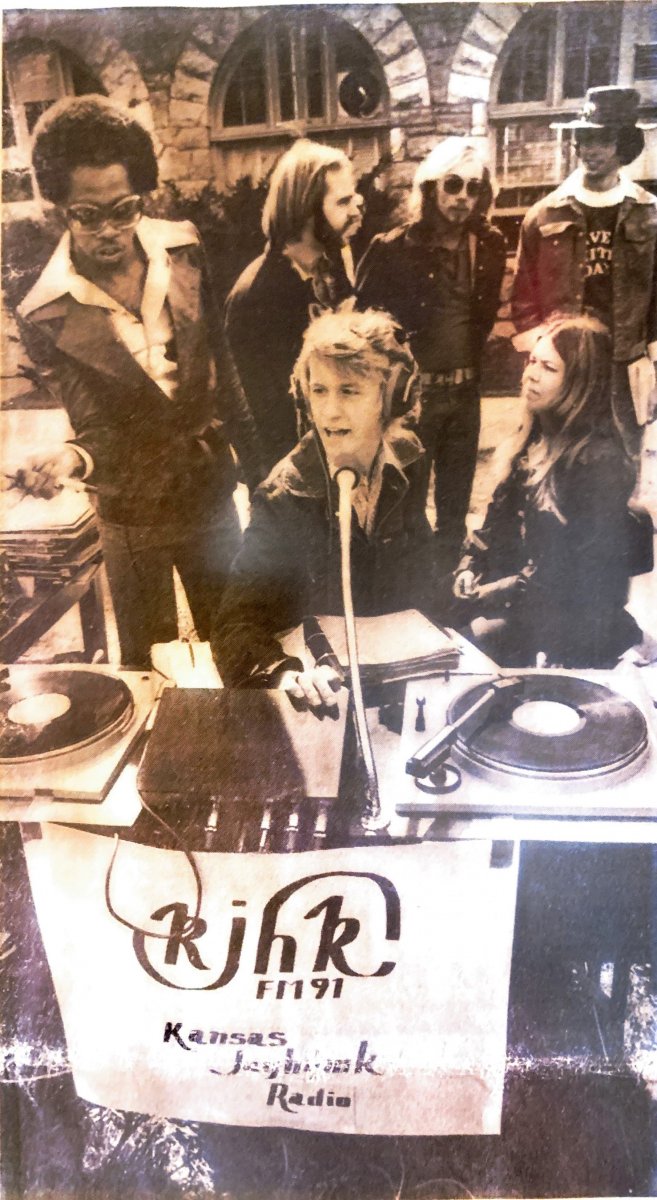
KJHK is born, and goes on air October 15 at precisely 12:25 p.m. Five weeks earlier, a helicopter and the Kansas National Guard placed KJHK’s radio antenna behind Marvin Hall. KJHK was the first student-run radio station on campus, but not the first radio station. KFKU, KANU and KUOK preceded KJHK.